
08 Jul Cast Iron Pipe Relining on the Northern Beaches: How Coastal Conditions Accelerate Failure in Older Homes
Every coastal homeowner knows that salt finds a way. It works its way into door hinges, light fittings, garden tools, outdoor furniture and the chrome on the barbecue. What most coastal homeowners do not realise is that it has been working on the cast iron in their drainage system for just as long. From Manly and Dee Why up through Collaroy, Narrabeen, Mona Vale and Newport to Avalon and Palm Beach, decades of salt-laden air have been quietly corroding pipework that the original builders fully expected to outlast the rest of the house.
It has not. Cast iron installed in Northern Beaches homes between the early twentieth century and the late 1970s is now showing the cumulative effects of a uniquely hostile environment, and the failures are surfacing across mid-century beach houses, post-war fibro renovations and substantial brick homes set back from the shoreline. Cast Iron Pipe Relining in Northern Beaches properties offers a way to address those failures without subjecting an already-stressed property to the further disruption of excavation through sandy, shifting ground.
Inside the Cast Iron Pipe Relining Process for Northern Beaches Homes
What makes the Northern Beaches different is not the presence of any single environmental factor, but the combination of three that all accelerate cast iron failure simultaneously. Salt drives external corrosion at exposed vent stacks, junctions and fittings. Sandy soils provide poor and shifting bedding that lets pipes settle, sag and joint-stress over time. And the periodic violence of east coast lows, which slam the coast between autumn and early winter, drives debris through stormwater systems, surcharges gully traps and saturates the ground around already-compromised pipework. The damage compounds. By the time a problem surfaces inside the home as a slow drain or a recurring blockage, the underlying cast iron pipe has often been deteriorating for years.
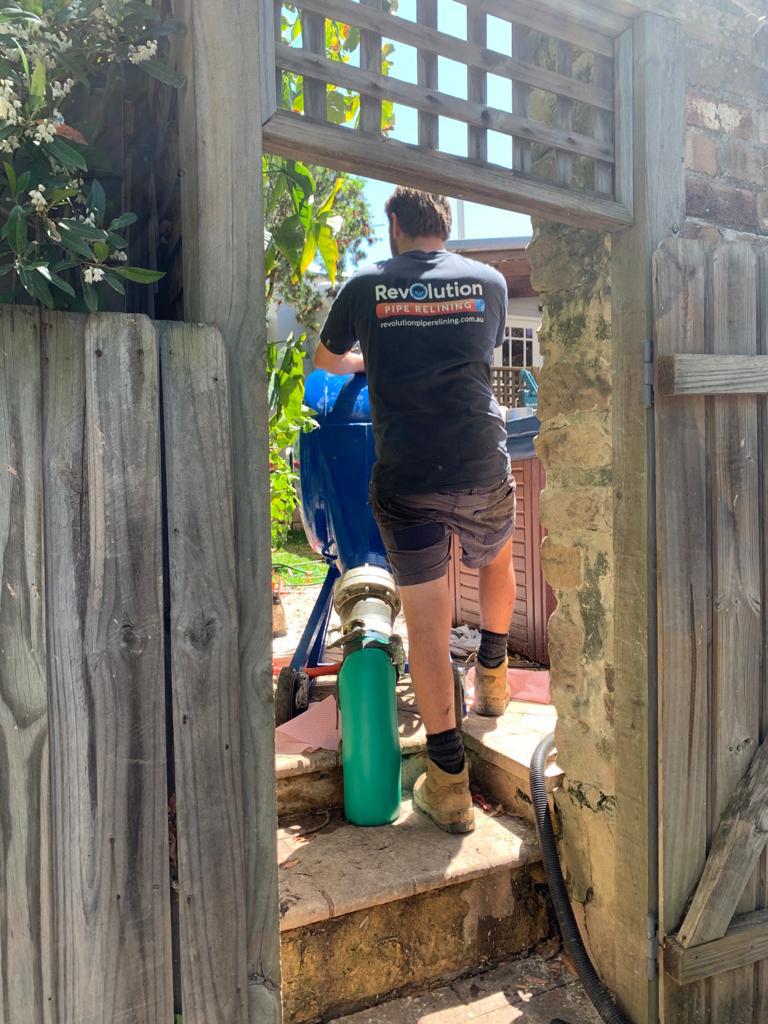
Replacing cast iron pipework on a Northern Beaches block is rarely a clean operation. Sandy ground does not hold its shape when trenched. Excavation walls require shoring, surrounding landscaping shifts as material moves, and reinstatement is a project in its own right. For homes on the dune-influenced flats behind Collaroy, Narrabeen and Newport, even modest excavation can destabilise nearby paving or pool surrounds. Cast iron pipe relining services in Northern Beaches homes were developed specifically to avoid all of this. The work proceeds from accessible points without disturbing the surrounding ground, which matters more on coastal soils than almost anywhere else in Sydney. Cast iron pipe relining services in Northern Beaches locations are now routinely written into renovation plans, pre-sale preparations and post-storm remediation programmes.
The technical decision-making for any individual property comes down to what a CCTV camera reveals. Cast iron pipe relining as a full-length treatment is appropriate where graphitisation has progressed through most of the pipe run, where multiple joints have weakened and where pinhole leaks have begun appearing at intervals along the line. In that scenario, relining cast iron drain pipe across its full length resolves every defect in a single continuous process, and the new resin-bonded structural wall is immune to the salt-driven corrosion that destroyed the original. Where the damage is concentrated at a discrete point, however, a cast iron pipe patch is the appropriate response. A cast iron pipe patch is particularly useful at coastal-facing junctions or short corroded sections where the rest of the line still has serviceable life. The choice between relining cast iron drain pipe in full and applying a targeted patch is always made from inspection footage, never from assumption.
Pipe relining cost on the Northern Beaches needs to be understood in the context of what reactive repair actually looks like in coastal conditions. The visible component of any cast iron failure is rarely the only one. A single corroded vent stack often signals broader graphitisation along the lateral run, and a single sagging joint usually indicates that bedding has been compromised along a longer section of pipe. Pipe relining cost varies according to pipe diameter, total length being treated, number of access points and whether the work involves vertical stacks, horizontal runs or both. For coastal homeowners, the relevant comparison is against the structural and landscaping cost of excavating through unstable soils, restabilising the ground, replacing pavers, lawn and plantings, and dealing with the salt and storm exposure of any disturbed area for months afterwards. Pipeline relining in Northern Beaches homes consistently emerges as the more controlled and predictable option once those reinstatement costs are fully accounted for. A scoped programme of pipeline relining in Northern Beaches properties begins with a CCTV inspection to confirm the actual condition of the pipework before any quote is committed to writing.
Take Action on Cast Iron Pipe Relining Across the Northern Beaches
Coastal homes deserve a coastal-specific approach to drainage rehabilitation, and cast iron is the material that responds best to specialist treatment. Revolution Pipe Relining works extensively across the Northern Beaches, combining high-definition CCTV diagnostics with trenchless relining and targeted patching tailored to the conditions of coastal pipework. Their licensed team understands how salt, sand and storm exposure compound over decades, and they design each project to minimise disruption to the gardens, driveways and finished surfaces that make Northern Beaches homes so valuable.
For Northern Beaches homeowners who would like a no-obligation quote on cast iron pipe relining or related drainage work, Revolution Pipe Relining can be reached on 1300 844 353. A short call now is the simplest way to understand the condition of the pipework and the realistic options for addressing it before the next storm season arrives.
No Comments